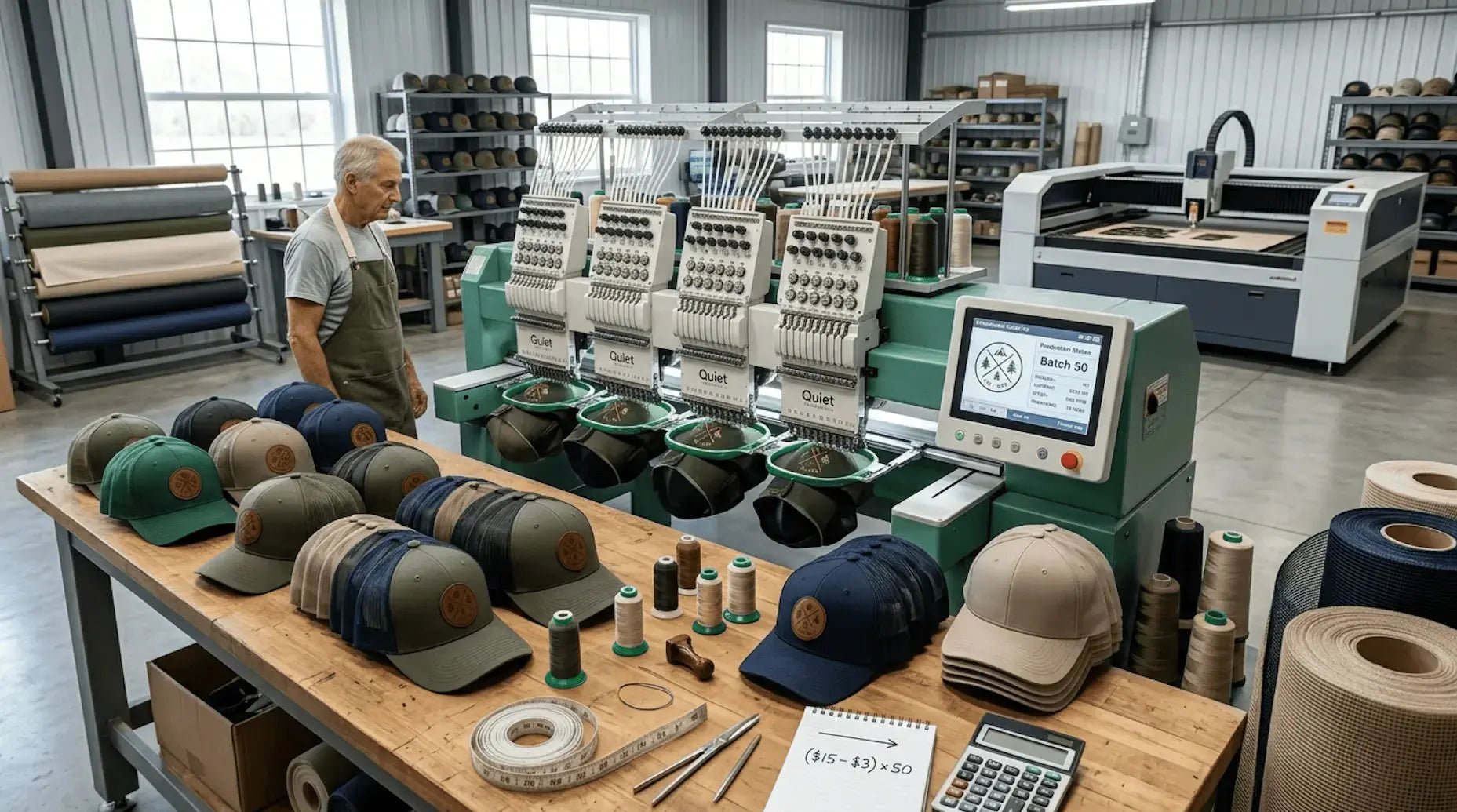
Sourcing hats and not sure where to start? Most buyers end up in the same place: Vietnam. This guide tells you exactly why — and gives you what you need to source there with confidence.
Vietnam's Rise as a Global Hat Manufacturing Hub
Vietnam is now the world's #2 hat exporter, right behind China.
That didn't happen by accident. Three forces drove it:
- The US-China trade war made Chinese factories more expensive overnight
- Free trade agreements opened up the EU and Pacific markets to Vietnamese exports
- Foreign investment poured in, upgrading factories and supply chains across the country
The numbers tell the story clearly.
Vietnam's hat exports grew 110.5% between 2019 and 2023 — the fastest growth rate of any country globally. Bangladesh grew 63%. The US grew 95.8% from a much smaller base. Vietnam beat them all.
And it's not slowing down.
- Vietnam's textile and garment exports hit $42 billion in 2024 — up 11% year-on-year
- Vietnam now accounts for 20.6% of all US apparel imports (up from 18.2% in 2023)
- The US, EU, Japan, and South Korea are all buying more from Vietnam every year
Still not convinced? Look at who's already manufacturing here: Nike, Adidas, Prada, Zara. Vietnam makes over half of all Nike shoes worldwide — nearly three times more Adidas footwear than China does.
If it's good enough for them, it's good enough for your hats.
Key Manufacturing Regions: Ho Chi Minh City, Hanoi & Binh Duong
Hat factories in Vietnam are clustered in three main areas.
Ho Chi Minh City (HCMC) is the export capital of southern Vietnam. Cat Lai — the country's largest container terminal — sits here, and most hat factories serving US and EU buyers are within 50–100 km of the port. If short export lead times are your priority, this is your region.
Binh Duong Province, just north of HCMC, is Vietnam's manufacturing heartland. The real advantage here is supply-chain density — embroidery houses, fabric suppliers, label makers, and packaging firms are often in the same industrial park as the hat factory itself. Fewer handoffs means faster lead times and fewer headaches.
Hanoi and the Northern Corridor covers Bac Ninh and Hung Yen provinces, exporting through Haiphong port. Wages run slightly lower than in HCMC, and the workforce is strong. This region suits buyers whose logistics point north toward East Asian or European markets.
Vietnam vs. China: Cost, Quality & Lead Time Comparison
Here's how the two countries stack up on the factors that actually matter.
Labor cost is the most obvious difference. Vietnam's average factory wage runs about $321/month, with HCMC and Binh Duong workers earning $344–$383. China's comparable manufacturing wages in Guangdong and Zhejiang range from $500 to $800/month — and they keep rising. Per hour, that's roughly $3.00 in Vietnam versus $6.50 in China. On a hand-intensive product like an embroidered baseball cap, a 50% labor cost advantage is significant.
Tariffs are where Vietnam's edge becomes structural. China faces US Section 301 tariffs of 25%+ on most apparel and accessories, with no relief in sight. Vietnam, following a February 2026 US Supreme Court ruling that struck down the IEEPA-based reciprocal tariff, is back to standard MFN rates of 6.8%–20% depending on the HTS code. For EU buyers, the picture is even clearer: the EVFTA is phasing Vietnamese headwear to 0% duty by 2027, a benefit China simply doesn't have access to.
Lead times favor China by sea — Shanghai to LA takes 16–20 days port-to-port versus 24–29 days from HCMC. But door-to-door, the gap narrows, and when you factor in the tariff-adjusted landed cost, Vietnam comes out lower for most buyers.
|
Route |
Vietnam (HCMC) |
China (Shanghai) |
|
To US West Coast |
24–29 days |
16–20 days |
|
Door-to-door |
37–41 days |
30–35 days |
|
Air freight |
5–10 days |
4–8 days |
Quality has improved dramatically. Vietnam now has 12,888 national quality standards in effect, with 60% aligned with international norms — up from 40% in 2013. The US Fashion Industry Association recently ranked Vietnam above both China and Bangladesh for high-value product diversity. The factories supplying global luxury brands here set the quality bar for the entire country.
Types of Hats Made in Vietnam
Baseball Caps, Bucket Hats, Straw Hats & More

Types of Hats Made in Vietnam
Baseball Caps, Bucket Hats, Straw Hats & More
Vietnam's hat manufacture industry covers virtually every headwear category. The most common styles produced for export include:
- Structured baseball caps — 5-panel, 6-panel, fitted, and snapback. Vietnam's highest-volume export. Multi-head Barudan and Tajima embroidery machines handle up to 12–15 thread colors per design. MOQs typically start at 300–500 pieces — lower than most Chinese factories.
- Bucket hats — Demand from Western fashion markets is surging. Vietnamese factories offer fast turnaround and flexible small-batch runs.
- Straw and natural fiber hats — Vietnam has deep artisanal roots here. The iconic nón lá leaf hat is practically a national symbol, and that tradition translates into real expertise with seagrass, raffia, paper straw, and toyo-straw.
- Beanies, trucker hats, dad hats, and performance caps — All standard configurations, produced year-round for US and EU markets.
Specialty & Fashion Hat Production in Vietnam
Vietnam is moving up the value chain. Luxury and fashion headwear is now a legitimate category — HCMC factories produce structured fashion hats with hand-stitched detail work, premium woven labels, and small-batch runs suited to independent brands. Prada manufactures bags in Vietnam. That tells you what these factories are capable of.
Custom embroidery and appliqué is a particular strength. Flatbed and 3D puff embroidery, woven patches, leather and PU patches, and heat-transfer applications are standard services at most hat manufacturers. Sustainable materials — GOTS-certified cotton, rPET, FSC-certified natural fibers — are increasingly available too, which matters for EU buyers navigating tightening sustainability disclosure rules.
How to Source Hats from Vietnam
Finding Factories vs. Using a Sourcing Agent
Going direct makes sense if you're ordering 5,000+ units per year, have in-house technical expertise, and can manage a relationship across the time zone gap. Start with SaigonTex in HCMC every April — the most efficient single event for meeting vetted Vietnamese hat manufacturers. Alibaba and Global Sources can supplement your search, but always verify independently before placing any order.
Using a sourcing agent is the better choice if you're new to Vietnam, working with smaller volumes, or short on bandwidth. A good agent charges 5–10% commission and handles the heavy lifting:
- Pre-qualifying factories before you visit
- Coordinating samples and managing revisions
- Arranging third-party quality inspections
- Handling all shipping documentation
For first-time Vietnam buyers, that commission pays for itself in time saved and mistakes avoided.
How to Verify a Vietnam Hat Factory
How to Verify a Vietnam Hat Factory
Start with the business registration. Vietnam's Ministry of Planning and Investment runs a national database at dangkykinhdoanh.gov.vn. Look up the factory's company name, tax ID, and registered address. If anything doesn't match what they told you, stop there.
Next, ask for compliance certificates. Reputable Vietnamese hat manufacturers typically hold at least one of the following:
|
Certificate |
What It Covers |
Required By |
|
BSCI |
Labor standards, health & safety |
EU retailers |
|
WRAP |
Social accountability |
US buyers |
|
ISO 9001 |
Quality management systems |
Premium brands |
|
SA 8000 |
Strongest labor standard |
Ethical / luxury brands |
Ask for the actual audit report, not just a certificate number. Legitimate factories provide these without hesitation. If they stall, walk away.
Then run a third-party inspection. Bureau Veritas, SGS, and QIMA all operate in Vietnam at $200–$400 per day. They'll verify production capacity, check equipment, review worker records, and evaluate raw material storage. Do this before every first production order.
Shipping, Tariffs & Logistics from Vietnam
Sea Freight vs. Air Freight from Vietnam
Sea Freight
This is the standard option for production orders.
Cat Lai port in HCMC connects to US and EU ports via daily departures from Maersk, ONE, CMA CGM, MSC, Evergreen, and others.
Transit times (port-to-port):
|
Route |
Transit Time (port-to-port) |
|
HCMC → Los Angeles / Long Beach |
24–29 days |
|
HCMC → New York / Savannah |
33–40 days |
|
HCMC → Rotterdam / Hamburg |
25–30 days |
Add 10–15 days door-to-door for customs clearance and inland trucking. Air freight — routing through Singapore, Hong Kong, or Bangkok — takes 5–10 days but costs $8–$15/kg versus $0.30–$0.60/kg by sea. Use it for samples and urgent replenishment only.
Import Duties for Hats from Vietnam to the US & EU
United States. Hats fall under HS Chapter 65, with baseball caps classified under subheading 6505.00. Standard MFN rates run 6.8%–20% depending on material. A 40% anti-transshipment duty remains firmly in place for goods made in China but relabeled as Vietnamese — and US Customs enforces it actively. Your factory must genuinely cut, sew, and finish hats in Vietnam. Audit their material sourcing before you commit.
European Union. The EVFTA eliminates tariffs on 99%+ of Vietnamese exports on a phased schedule, with most headwear hitting 0% duty by 2027. To claim the rate, factories must provide a EUR.1 movement certificate or REX statement of origin. The catch: fabric must originate in Vietnam, the EU, or qualifying ASEAN or South Korean suppliers. Chinese-sourced fabric — even if the hat is sewn entirely in Vietnam — generally won't qualify. Ask your factory where their fabric comes from, and get it in writing.
Vietnam's CPTPP membership adds preferential duty access in Japan, Canada, Australia, and eight other member countries — another layer of cost advantage for buyers serving those markets.
Top Vietnam Hat Manufacturers to Consider
The most reputable Vietnam hat manufacturers share a consistent profile: 10+ years in operation, an established Western client base, at least one major social compliance certification, and full transparency about production capacity and material sourcing. If a factory can't clearly answer those questions, keep looking.
For your factory search, focus on Binh Duong Province (VSIP I, VSIP II, My Phuoc industrial zones) for the highest concentration of hat manufacturers and the most integrated supply chains. HCMC's Export Processing Zones (Linh Trung, Tan Thuan) offer the closest proximity to Cat Lai port and the fastest export lead times. Dong Nai Province, adjacent to both, is a growing cluster of mid-tier factories often at slightly lower cost.
Attend SaigonTex in April and register with VITAS (Vietnam Textile and Apparel Association) as a foreign buyer — they provide introductions to vetted manufacturers. If you don't have in-country contacts yet, bring in a sourcing agent for your first order.
Vietnam's hat manufacture industry isn't a contingency plan. It's a first choice. The labor cost advantage is real. The trade deal benefits are locked in. The quality is proven by the biggest brands on earth.
The only question is which factory is the right fit — and how fast you want to get started.
FAQ
What is the MOQ for Vietnamese hat factories?
Typically 300–500 pieces for standard export styles like baseball caps. This entry barrier is generally lower than what is required by most Chinese factories.
How do I communicate with a Vietnam manufacturer?
- Go Direct: Best if you order 5,000+ units/year. You can source partners via Alibaba, Global Sources, or face-to-face at the SaigonTex expo in Ho Chi Minh City every April.
- Use a Sourcing Agent: Recommended for smaller volumes or beginners. For a 5–10% commission, they handle factory vetting, sample revisions, QA inspections, and shipping logistics.
Is hat quality from Vietnam reliable?
Yes, it is highly reliable. Vietnam enforces 12,888 national quality standards (60% aligned with international norms). Its manufacturing capabilities are proven and trusted by global giants like Nike, Adidas, Prada, and Zara.
How long does shipping from Vietnam to the US take?
- Sea Freight (Port-to-Port): 24–29 days to the US West Coast; 33–40 days to the US East Coast.
- Door-to-Door: Add 10–15 days to sea transit for customs clearance and local trucking.
- Air Freight: 5–10 days, but best reserved strictly for samples or urgent stock replenishment due to higher costs.