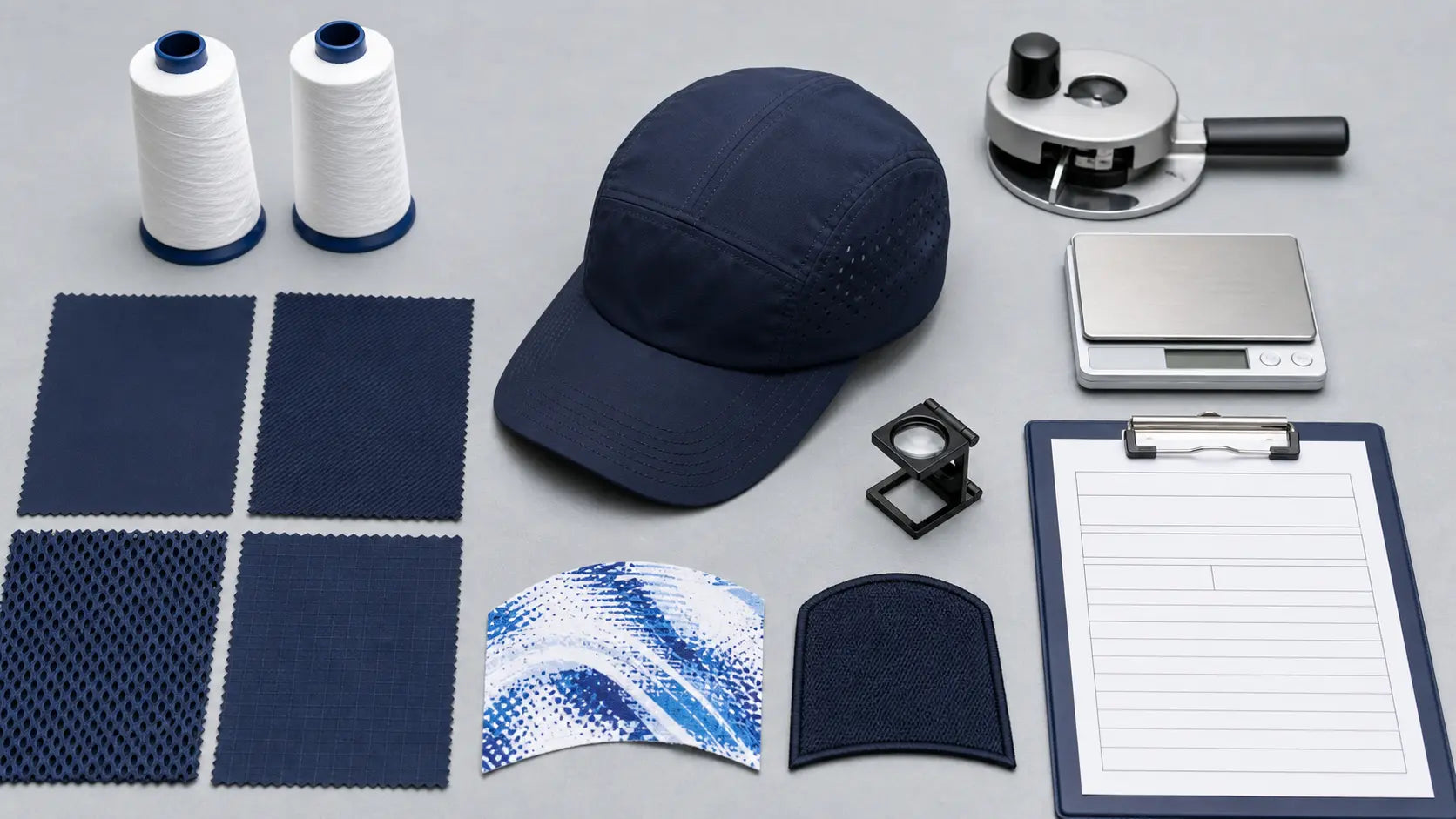
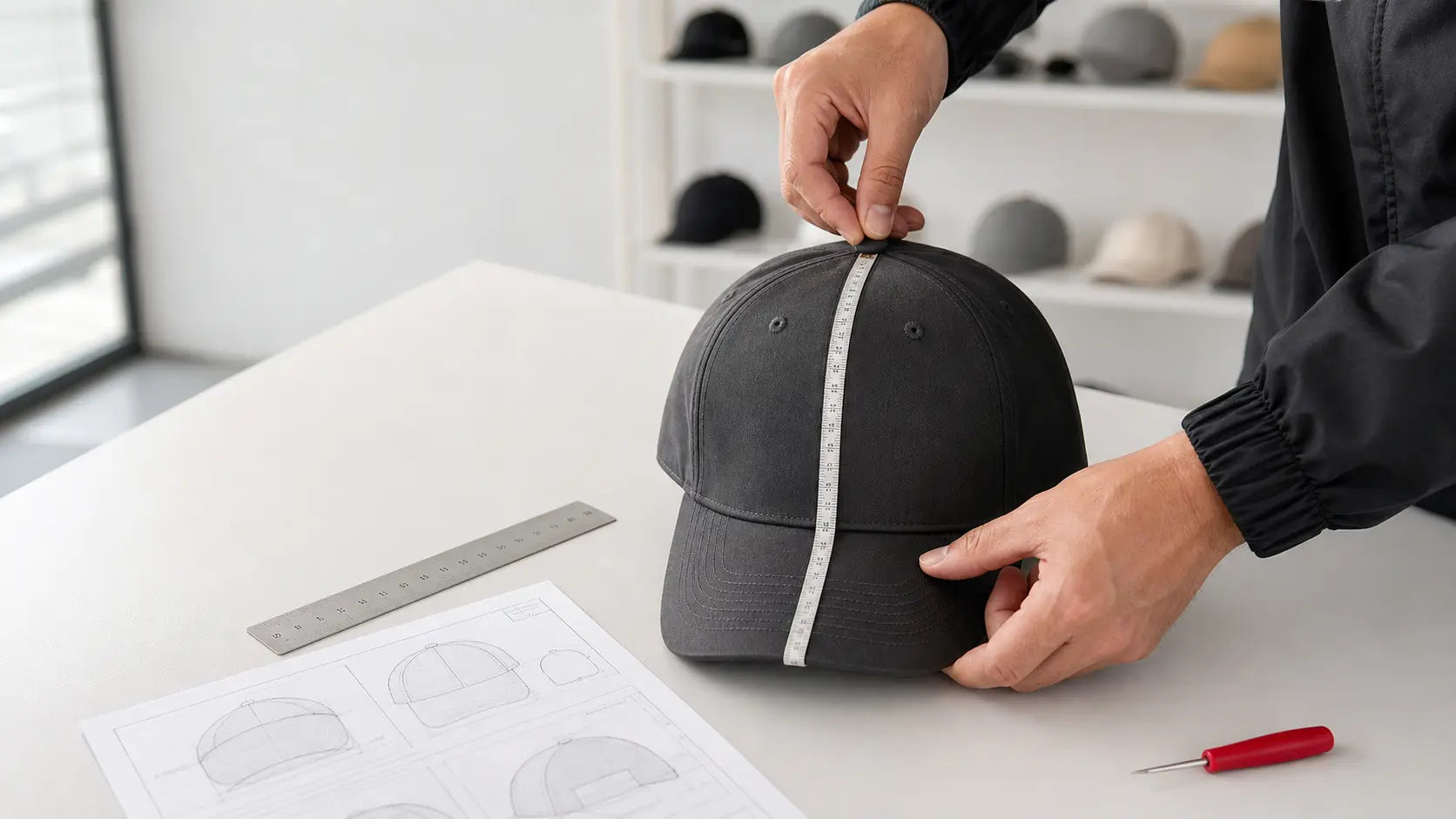
“Use a heavy cotton canvas.”
It sounds clear. It is not measurable.
One supplier may call 260 g/m² heavy. Your reference cap may use 380 g/m². Both sides can follow the same adjective and still produce different hats.
That gap becomes expensive after sampling.
The crown may collapse. The seams may become too bulky. The logo may pucker. A garment wash may change the size, shade or visor curve.
The solution is simple: turn each description into a number, a process and an approval standard.
For cotton headwear, start with three fabric parameters:
· Yarn count
· Construction or thread density
· Finished fabric weight in GSM
Then define the wash stage, colourfastness tests and decoration setup.
Turn Fabric Adjectives into Measurable Fields
Cotton identifies the fibre. It does not identify the finished fabric.
A factory-ready woven fabric specification should include:
|
Field |
What to state |
Why it matters |
|
Fibre content |
100% cotton, or the exact blend |
Confirms the raw material |
|
Yarn count |
Warp × weft in Ne, tex or another named system |
Indicates yarn fineness or mass |
|
Construction |
Ends per inch × picks per inch, or metric equivalent |
Shows how tightly the fabric is woven |
|
Weave |
Plain, 2/1 twill, 3/1 twill, canvas or another structure |
Affects surface, drape and strength |
|
Finished weight |
Target GSM plus tolerance |
Controls body, warmth and seam bulk |
|
Dye and finish |
Piece dyed, yarn dyed, brushed, coated, preshrunk and so on |
Affects shade, hand feel and performance |
|
Approval reference |
Swatch number, lab dip and sealed sample |
Gives both sides a physical benchmark |

Read Yarn Count Correctly
Yarn count needs a named system.
In the English cotton count system, shown as Ne, a higher number means a finer yarn. In the tex system, a higher number means a heavier or coarser yarn because tex records grams per kilometre.
Never write “20-count yarn” without naming the system.
Record Construction as Warp × Weft
Woven construction is commonly written as ends per inch × picks per inch.
Ends run in the warp direction. Picks run in the weft or filling direction.
Two 260 GSM twills can still feel different if their yarn count, construction or finish differs. GSM alone cannot replace the full construction.
Define GSM on the Finished Fabric
GSM means grams per square metre.
State whether the value applies before or after dyeing, finishing and washing. For purchasing, the finished condition is usually the useful reference.
Also state a tolerance. For example:
Illustrative specification: 100% cotton, 20 Ne × 16 Ne, 128 × 60 EPI/PPI, 3/1 twill, finished 260 GSM ±5%, piece dyed and preshrunk.
This is a format example. It is not a universal recommendation for every cap.
Words such as light, standard and heavy can remain in the design brief. Define the internal range behind each word for that project.
Match the Fabric to the Hat Structure
The fabric and cap construction work together.
|
Fabric direction |
Common use |
Production questions |
|
Twill |
Baseball caps, dad caps and workwear styles |
What twill line, construction, GSM and finish are required? |
|
Canvas |
Firm five-panel caps and substantial bucket hats |
Will seam intersections become too thick? Can the machine sew the selected stack? |
|
Poplin or broadcloth |
Lightweight caps and soft summer hats |
Does the front panel need support? Will the decoration distort the fabric? |
|
Brushed or peached cotton |
Soft lifestyle caps |
What is the nap direction? Will fibres cover fine embroidery details? |
A lightweight fabric can work on a structured cap when the internal support is engineered for it.
A heavy canvas can still fail if the seam stack is too thick or the crown shape is wrong.
Approve the fabric, support materials and completed hat as one construction.
Separate Fabric Wash from Garment Wash
“Washed cotton” hides the most important question: when is the washing done?
 Fabric Wash
The mill washes or finishes the fabric before cutting.
The factory then cuts the hat from the treated roll. Fabric dimensional change can be checked before production, for example with AATCC TM135 when home-laundering performance is relevant.
The tech pack should record:
· Fabric wash or finishing process
· Finished GSM and construction
· Residual shrinkage requirement
· Shade and hand-feel reference
· Roll and lot control
Garment Wash
The factory makes the hat first and washes the assembled product.
This can create the relaxed, aged appearance used on many dad caps. It also exposes the visor insert, sweatband, embroidery, thread, labels and closure to the same wash and drying process.
Possible failures include:
· Visor warpage or loss of the approved curve
· Crown and head-opening shrinkage
· Embroidery puckering or raised edges
· Colour transfer between components
· Uneven fading between panels
The risk depends on the full wash recipe and the materials used. “PE board” alone does not prove wash resistance.
Control a Garment-Wash Program
1. Specify the sequence: wash before decoration or wash after decoration.
2. Record the machine type, temperature, pH, chemicals or enzymes, time, mechanical action and drying method.
3. Use preshrunk or pretested fabric where required.
4. Qualify the visor insert, sweatband, thread, labels and closure against that exact recipe.
5. Measure the completed hat before and after washing. AATCC TM150 is the garment-level reference when home-laundering dimensional change applies.
6. Approve post-wash size, shade, visor curve and logo appearance on a sealed sample.
7. Run a pilot wash before bulk production and compare the first bulk lot with the sealed sample.
Changing the wash recipe after approval creates a new product condition. Test it again.
Add Colourfastness to the Purchase Specification
Caps meet sweat, sunlight and repeated rubbing.
Colour approval under a light box does not show how the dye will perform during use.
Request test reports on the finished colour and finish:
|
Risk |
Test reference |
What it checks |
|
Perspiration |
AATCC TM15 or the agreed market equivalent |
Colour change and staining after acid perspiration exposure |
|
Dry and wet rubbing |
AATCC TM8 or ISO 105-X12 |
Colour transferred by rubbing in dry and wet conditions |
|
Light exposure |
AATCC TM16.3 or an agreed ISO 105-B method |
Colour change under controlled light exposure |
|
Laundering, when relevant |
AATCC TM61 or the required care-method standard |
Accelerated colour change and staining from washing |
Do not write “good colourfastness.”
Write the test method, option, minimum grade and acceptance rule. The correct grade depends on the destination market, colour, intended use and brand standard.
Dark and highly saturated cotton colours deserve extra attention. Test the exact bulk dye lot. Dye class, fixation and after-treatment can change the result.
Engineer Embroidery for the Actual Surface
“Use backing” is too broad for production.
The fabric, stitch file and stabilising system must be tested together.
|
Fabric or condition |
Common failure |
Factory-ready direction |
|
Brushed or peached cotton |
Stitches sink into the nap and fine edges look soft |
Add a water-soluble topping when the sew-out shows sinking. Define underlay and check that residue can be removed without marking the fabric. |
|
Lightweight poplin |
Puckering around the logo |
Use a stable hooping setup and a cut-away backing selected for logo size and stitch count. Adjust stitch density, underlay and pull compensation. Approve a sew-out on the actual panel. |
|
Heavy canvas |
Needle stress, thread breaks and a board-like logo area |
Review needle and thread choice, reduce unnecessary stitch density and check seam clearance. |
|
Garment-washed cap |
Logo shrinkage, raised edges or uneven fading |
State whether embroidery happens before or after washing. Test the complete sequence, including backing removal and drying. |
An 80 GSM backing can be a useful trial for some lightweight woven fabrics. It is not a universal minimum.
Commercial references range from roughly 30–55 GSM lightweight cut-away products to about 92 GSM cut-away products for lightly woven shirts. Logo area, stitch count, fabric stability, hooping and wash method determine the final choice.
The approval should record:
· Backing type, weight and number of layers
· Topping type, if used
· Stitch count and finished logo size
· Underlay and pull-compensation settings
· Needle and thread specification
· Approved sew-out on the production fabric
Use a Short Cotton Approval Checklist
Before approving bulk fabric, confirm:
8. Fibre content
9. Yarn-count system and warp × weft values
10. EPI × PPI construction
11. Weave structure
12. Finished GSM and tolerance
13. Dye method, finish and physical colour reference
14. Fabric wash or garment wash
15. Complete wash recipe and sequence
16. Residual fabric shrinkage and post-wash hat dimensions
17. Perspiration, wet rubbing and light-fastness requirements
18. Decoration setup and approved sew-out
19. Sealed finished sample and bulk acceptance rules
If any field is unknown, ask the supplier to propose a value and test it.
Do not leave the field as an adjective.
Approve a Repeatable Product
A cotton cap should be easy to describe, test and reproduce.
Use three steps:
Specify: Record yarn count, construction, GSM, finish and wash stage.
Test: Check colourfastness, dimensional change and decoration on the actual materials.
Approve: Seal the swatch, sew-out and finished hat with revision numbers.
Send FOREMOST your reference cap, target use, decoration artwork, quantity and destination market. The development team can then propose a measurable fabric and testing plan for sampling.
Frequently Asked Questions
What information should follow “100% cotton” in a cap specification?
Add yarn count, EPI × PPI construction, weave, finished GSM with tolerance, dye method, finish and a physical approval reference.
These fields give the factory measurable targets.
Is 260 GSM cotton considered heavy?
“Heavy” has no universal purchasing definition.
One brand may classify 260 GSM as heavy while another expects 380 GSM. Record the actual GSM and tolerance instead of relying on the adjective.
What is the difference between fabric wash and garment wash?
Fabric wash happens before cutting. Garment wash happens after the hat is assembled.
Garment washing also exposes the visor insert, sweatband, embroidery, labels, thread and closure to the wash process, so the complete hat must be tested.
Which colourfastness tests matter for a cotton cap?
Start with perspiration, dry and wet rubbing, and light fastness. Add laundering when the care method or wash program requires it.
The specification must name the test method, option, minimum grade and acceptance rule.
Does lightweight poplin always need 80 GSM embroidery backing?
No single backing weight works for every logo and fabric.
Select the backing with the stitch count, logo size, hooping, fabric stability and wash process in mind. Approve a sew-out on the production fabric.
Frequently Asked Questions
What information should follow “100% cotton” in a cap specification?
Add yarn count, EPI × PPI construction, weave, finished GSM with tolerance, dye method, finish and a physical approval reference. These fields give the factory measurable targets.
Is 260 GSM cotton considered heavy?
“Heavy” has no universal purchasing definition. One brand may classify 260 GSM as heavy while another expects 380 GSM. Record the actual GSM and tolerance instead of relying on the adjective.
What is the difference between fabric wash and garment wash?
Fabric wash happens before cutting. Garment wash happens after the hat is assembled. Garment washing exposes all cap components to the process, so the complete hat must be tested.
Which colourfastness tests matter for a cotton cap?
Start with perspiration, dry and wet rubbing, and light fastness. Add laundering when the care method or wash program requires it. Name the test method, option, minimum grade and acceptance rule.
Does lightweight poplin always need 80 GSM embroidery backing?
No single backing weight works for every logo and fabric. Select it with the stitch count, logo size, hooping, fabric stability and wash process in mind, then approve a sew-out on the production fabric.