Sourcing a hat supplier isn't just about comparing quotes. Here's how to tell a real factory from a rebranded trading company, verify certifications properly, and use your sample order as the real test before committing to bulk.
We've written before about the basic checklist for picking a hat manufacturer — scale, certifications, MOQ, and so on. This time we want to go one layer deeper, into the part most buyers skip: how to actually verify that a supplier is who they say they are, and how to catch the warning signs before you've wired a deposit.
🔽 Quick Navigation
- 📌 Why Supplier Selection Matters More Than It Looks
- 📌 Factory vs Trading Company: How to Tell the Difference
- 📌 How to Actually Verify Certifications
- 📌 Evaluating Production Capacity and Quality Control
- 📌 The Sample Order Is Your Real Test
- 📌 Communication, Lead Times, and After-Sales Support
- 📌 Conclusion
- ❓FAQ
Why Supplier Selection Matters More Than It Looks

For most brands, a hat is a small line item in a much bigger launch — a merch drop, a uniform order, a promotional giveaway. But a bad supplier decision doesn't just cost you the price of the hats. It costs you the time you spent designing them, the marketing calendar built around a launch date, and in some cases, your relationship with the retailer or customer waiting on the other end.
Sourcing custom headwear usually means working with an overseas factory, sight unseen, based on photos, a sample, and a sales pitch. That gap between what you're shown and what you actually get is exactly where supplier selection either saves you or costs you. Our own Company Profile page is an example of the kind of concrete history — founding year, factory count, staff numbers — a real manufacturer should be able to show you.
Factory vs Trading Company: How to Tell the Difference

This is the single biggest distinction buyers miss, and it's worth understanding before you look at anything else. In the wholesale hat industry, a significant share of listings on B2B marketplaces belong to trading companies — businesses that take your order, then outsource production to a factory they don't own or fully control. That's not automatically a scam, but it does mean an extra layer between you and the people actually making your hats, with less visibility into quality control and less accountability if something goes wrong. A few ways to tell the difference:
- Ask directly which factory will produce your order, and ask for the factory's name and location — a real manufacturer will answer without hesitation
- Request a factory tour, live video call, or recent photos of the production floor — a trading company will often stall, redirect, or provide stock images instead
- Check whether the company can answer detailed production questions — things like panel construction, stitch counts, or specific machinery. Trading company sales reps often can't go beyond what's on the product page.
- Look for consistency between the company's stated scale and what they can show you — a company claiming multiple factories and tens of thousands of monthly units should be able to back that up with real production data.
How to Actually Verify Certifications
 A logo on a website homepage is not verification. Certifications like ISO 9001, BSCI, GRS (Global Recycled Standard), and GOTS (Global Organic Textile Standard) all involve real audit processes — which means they're also real things you can ask to see proof of.
- Ask for the certificate number and issuing body, then look up the certification directly through the issuing organization's public database where one exists, rather than trusting a PDF the supplier sends you
- Check the certificate's scope — some certifications apply to a specific factory or product line, not the entire company, so a valid certificate for one facility doesn't automatically cover every hat in their catalog
- Confirm the certificate hasn't expired — most of these require annual renewal, and an outdated certificate is effectively meaningless
If you're evaluating a supplier's sustainability claims specifically, this is worth doing carefully — regulators and customers are increasingly asking brands to back up "sustainable" and "eco-friendly" labeling with real documentation, not just a claim. For example, when a supplier says their factories are BSCI, ISO, GRS, and GOTS certified, that's a specific, checkable claim — you can ask which facility holds which certificate and request the documentation directly, rather than taking a homepage badge at face value.
Evaluating Production Capacity and Quality Control
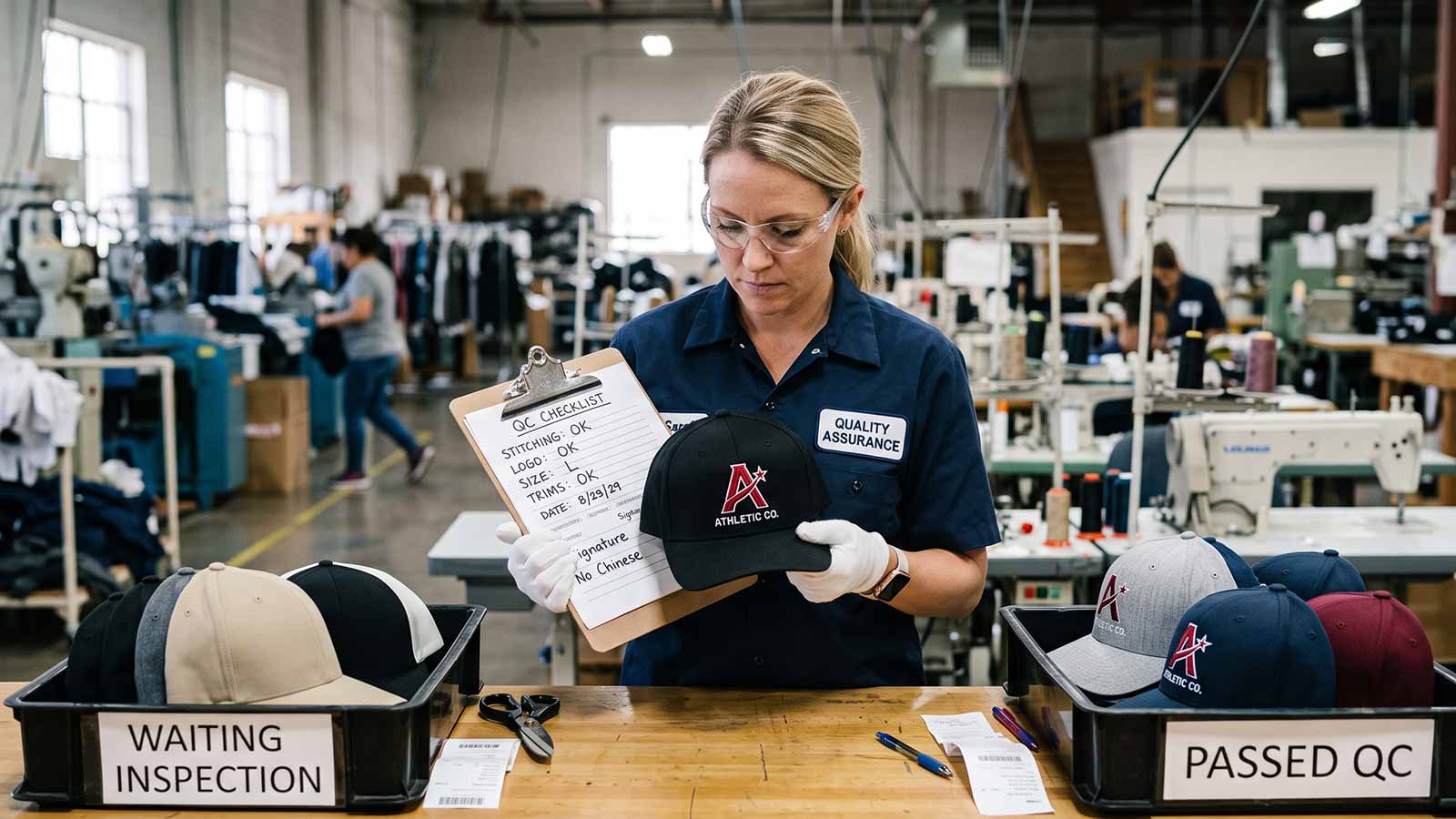
Beyond certifications, ask what the actual quality control process looks like at each stage of production. A supplier with a mature system should be able to describe something like: incoming material inspection, in-line checks during production, and a final random-sample inspection before shipment — commonly following an AQL (Acceptable Quality Limit) standard, which sets a defined threshold for how many defects are allowed in a sampled batch before the whole shipment is rejected.
As a point of reference, our own Factory Show page lays out exactly this kind of detail — five factories across China, Vietnam, and Cambodia, in-line inspection at each production station, and a stated production volume of over 2.3 million hats per month. The specifics will vary by supplier, but the level of detail you should expect to see is the same: real numbers, real locations, not vague claims.
The Sample Order Is Your Real Test
 No amount of research replaces actually holding a sample in your hands. A sample order tells you things a spec sheet can't:
- Whether the stitching, fabric weight, and construction match what was described
- How closely the sample color matches your brand's Pantone or hex reference
- Whether the embroidery or print quality holds up at a small scale, not just in a photo
- How the supplier handles the sample process itself — response time, clarity of communication, and whether they push back constructively on anything unrealistic in your spec
Treat the sample stage as a trial run for the entire relationship, not just the product. A supplier that's slow, vague, or hard to reach during a small sample order is unlikely to improve once you've placed a bulk order and the leverage has shifted. It's also worth ordering your sample through the same channel you'd use for a real order — if a supplier fast-tracks a single sample through a senior team member but routes everyday communication through a junior rep with limited authority, that gap is worth asking about before you commit to volume.
Communication, Lead Times, and After-Sales Support
The final piece is less exciting but just as important: what happens after the order ships. Ask specifically:
- What's the standard lead time from sample approval to bulk shipment, and does that timeline hold up during peak seasons?
- What's the process if a batch arrives with a defect rate above what was agreed?
- Is there a dedicated point of contact for your account, or will you be routed through a general sales inbox each time?
A supplier that can answer these clearly, before you've placed an order, is telling you something useful about how they'll behave after you have. As a baseline for comparison, our own FAQ & Policies page spells out our MOQ tiers and quoting process in writing — that kind of publicly documented policy is itself a useful signal, since it gives you something to hold the supplier to later.
Conclusion
Choosing a high-quality supplier isn't about finding the lowest quote — it's about finding a partner whose claims you can actually verify: a real factory you can ask to see, certifications you can look up independently, and a sample process that tells the truth about what bulk production will look like. The extra hour spent verifying these details upfront is almost always cheaper than the cost of discovering a problem after a deposit is already wired.
❓FAQ
Q1: How do I know if a supplier is a real factory or a trading company?
Ask directly for the factory name and location, request a video call or recent production photos, and see whether their team can answer detailed technical questions about construction and materials. Vague answers or a reluctance to name the factory are red flags.
Q2: Are lower prices from smaller suppliers always a red flag?
Not necessarily — smaller or more specialized factories can genuinely offer more flexibility and lower MOQs. The concern isn't size itself, but whether the supplier can back up their claims about capacity, certifications, and quality control with real evidence.
Q3: Is it worth paying more for a certified supplier?
If your brand markets products as sustainable, ethically made, or premium-quality, certifications like BSCI, ISO 9001, GRS, or GOTS give you something concrete to point to if a customer or retailer asks for proof — which can be worth the modest price premium.
Q4: How many samples should I order before committing to a bulk order?
Most buyers order one sample round to check fit, material, and construction, then a second "pre-production" sample once any adjustments are made, before approving bulk production. Skipping the second round is one of the most common ways quality issues slip through.