Almost every hat factory claims to offer "high quality." A well-designed website, a few product images, and seemingly competitive quotes are often enough to start a potential partnership. However, brands that have truly experienced supply chain collaboration understand that judging whether a hat manufacturer is reliable cannot rely only on marketing materials. The evaluation should return to verifiable manufacturing capabilities: whether the manufacturer has a stable global production network, a complete manufacturing process, fast sampling capabilities, and the ability to maintain consistent quality throughout large-volume orders.
Taking Foremost Hat as an example, a company that has long specialized in hat manufacturing, its multi-regional factory network, large-scale production system, and complete process from product development to quality management demonstrate how these core capabilities are applied in real manufacturing.
🔽 Quick Navigation
- 📌 Why Multi-Country Factory Layout Creates Real Competitive Advantage
- 📌 Why Owning Every Stage While Staying Flexible Matters
- 📌 How a Strong Development Team Drives Innovation and Speed-to-Market
- 📌 How Inspection Standards and Certified Materials Build Trust
- 📌 Why Decades of Experience and Training Cannot Be Copied
- 📌 How Factory Strength Directly Translates Into Brand Growth and Customer Trust
- ❓FAQ
Why Multi-Country Factory Layout Creates Real Competitive Advantage

Suppliers that operate factories in only one country are often more vulnerable to external factors such as labor shortages, tariff changes, port congestion, and raw material price fluctuations. In comparison, mature hat manufacturers usually reduce supply chain risks through multi-country production networks. For example, they may establish production bases in China, Vietnam, and Cambodia, and allocate orders based on each factory's manufacturing strengths: some specialize in woven baseball caps, some focus on knitted beanies, while others have accumulated expertise in special categories such as straw hats and wool hats. This approach not only helps diversify risks but also allows brands to adjust production capacity more flexibly during trade policy changes or peak-season order increases, while maintaining consistent quality standards and stable delivery performance.
Building such a global manufacturing system cannot be achieved in the short term. It requires long-term investment in factory certifications, team development, supply chain integration, and continuous accumulation of production management experience. Therefore, hat manufacturers capable of coordinating production across multiple countries usually have stronger large-scale manufacturing capabilities, with monthly production capacity reaching millions of units. Taking Foremost Hat's multi-regional production system as an example, its factories in different countries collaborate based on product categories and manufacturing advantages. This demonstrates the value of a mature supply chain in real procurement and shows that global production is not simply about displaying scale, but about improving order flexibility and stability for brands.
Why Owning Every Stage While Staying Flexible Matters
Many so-called "factories" are actually closer to trading service providers, outsourcing key processes such as cutting, sewing, embroidery, and finishing to third parties. While this model allows them to take on orders quickly, it can also increase communication costs through multiple layers of coordination, leading to quality fluctuations and unstable delivery times. A truly capable hat manufacturer usually establishes a complete in-house production system, integrating pattern development, fabric cutting, sewing, hat shaping, brim forming, decoration processing, and final quality inspection into a unified management process. For example, some mature manufacturers use a complete production and delivery process to connect each stage efficiently, reducing external dependence and improving order execution stability. For brands, this means less information loss, clearer production milestones, and faster responses to design changes or urgent orders.
However, mastering the full production process does not mean that all orders must be produced in the same way. An experienced hat manufacturer also needs enough production flexibility to handle both large-scale projects and small-batch custom developments. This capability usually comes from automated cutting equipment, digital production management, specialized technical teams, and adjustable production line configurations. Manufacturing models that combine multi-country factory networks and integrated production systems essentially improve order adaptability through different resource combinations, allowing the production system to adjust according to brand requirements rather than limiting brands to a single production model.
How a Strong Development Team Drives Innovation and Speed-to-Market

Production capacity alone cannot fully determine the competitiveness of a hat factory. The real difference often comes from research, development, and innovation capabilities. Mature hat manufacturers usually have professional design teams, fabric development teams, and dedicated sample centers to transform design concepts into physical products through rapid prototyping systems. Some leading factories can complete the entire process from sketches and material selection to sample production within a short period of time, while continuously developing new products that match market trends. At the same time, their R&D capabilities also extend to material innovation, allowing manufacturers with fabric development expertise to explore more valuable sustainable solutions, such as recycled yarns and organic blended materials.
For brands that need to respond quickly to market changes, a supplier's development efficiency is often more important than simple price advantages. Taking manufacturers with years of experience in hat development as an example, their company profile pages showcase complete capabilities ranging from design development to new product planning. These R&D resources can help brands shorten product launch cycles and capture constantly changing consumer trends. After all, once a sales opportunity is missed, even lower production costs are unlikely to make up for the loss of market potential.
How Inspection Standards and Certified Materials Build Trust

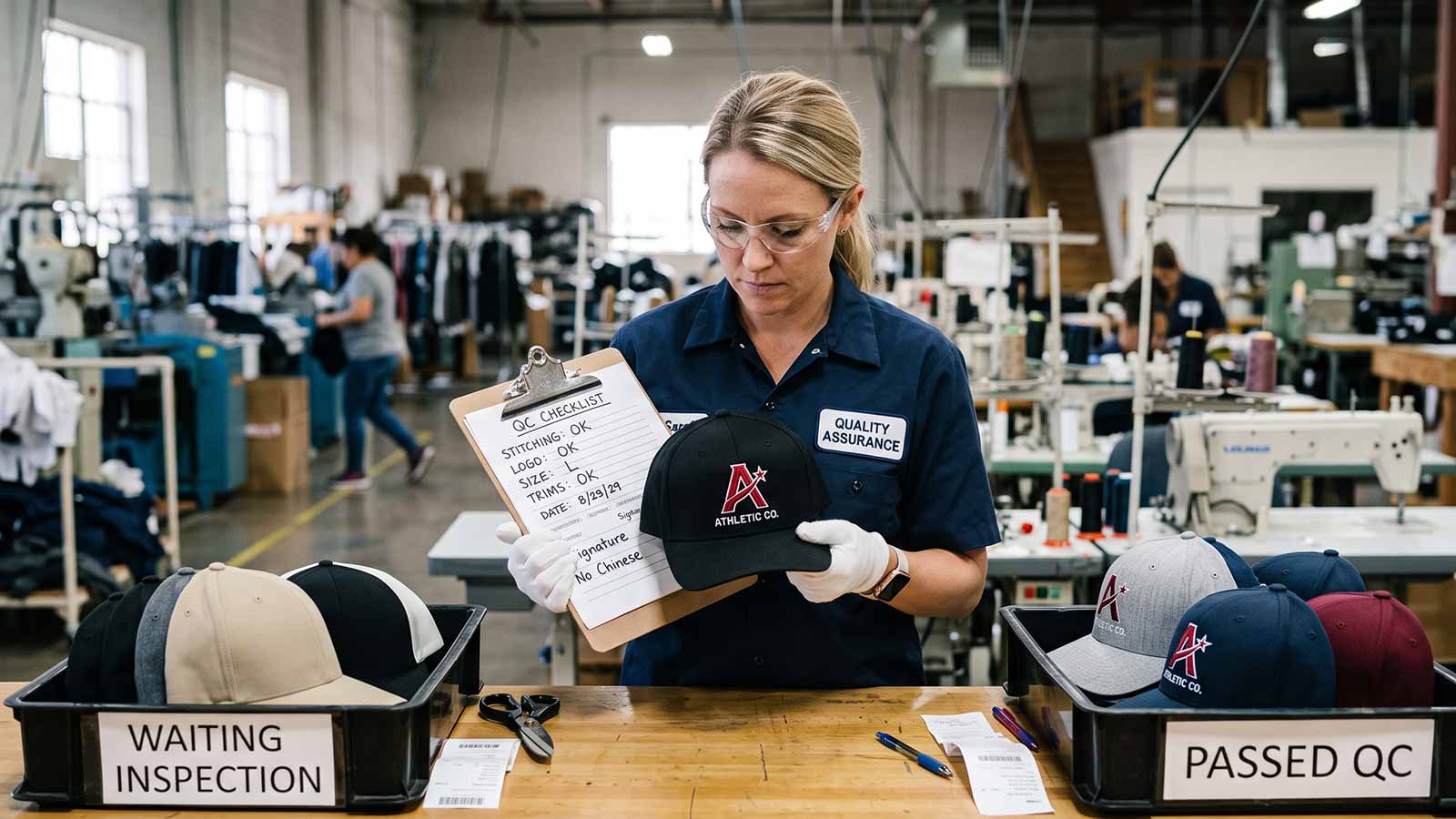
Quality control should never be limited to a single inspection after production is completed. Instead, it should run throughout the entire manufacturing process. Truly mature hat factories usually establish multi-stage quality management systems, including incoming material inspections, online production monitoring, semi-finished product inspections, and pre-shipment random checks, allowing issues to be identified and corrected at the stage where the cost of fixing them is lowest. When production spans multiple countries, maintaining unified quality standards becomes even more important. If different factories follow different inspection procedures, quality differences between batches can easily occur. Therefore, manufacturers with global supply capabilities usually implement consistent specifications, inspection processes, and quality checklists across all production bases to ensure product consistency regardless of manufacturing location. For example, a complete quality control system allows buyers to better understand how manufacturers use standardized management to maintain stability in large-volume orders.
Likewise, truly reliable manufacturing capabilities are also reflected in material selection and sustainable production practices. Environmental commitments should not be just marketing statements; they need to be verified through actual certifications and supply chain management. Leading factories typically use certified sustainable materials, such as GRS-certified recycled polyester, GOTS-certified organic cotton, and RWS-certified wool, along with more environmentally friendly finishing and packaging solutions. They also undergo relevant audits such as BSCI, ISO, WRAP, and SLCP. Manufacturers that demonstrate their material certifications, sustainability initiatives, and supply chain management through a sustainability system allow brands to better evaluate their long-term partnership value. After all, traceable certification systems require continuous investment and long-term accumulation. Factories that can provide complete documentation have a clear advantage over suppliers that only rely on marketing claims about being "eco-friendly."
Why Decades of Experience and Training Cannot Be Copied

Machines can be purchased by any competitor with capital. A trained workforce with decades of accumulated craft knowledge cannot. Hat-making still depends heavily on manual skill — precise crown shaping, hand-finished brims, straw braiding, felt blocking — techniques that take years to master. Factories with a long operating history, some spanning nearly three decades, have built internal training systems that pass this expertise to new hires, preserving construction quality even as production scales into the millions of units per month.
How Factory Strength Directly Translates Into Brand Growth and Customer Trust
Every condition above compounds into a single outcome: reliability a brand can build on. A multi-country footprint protects delivery timelines. In-house production and flexible scale protect quality, cost, and order fit. A strong R&D team protects speed-to-market. Layered inspection and certified sustainability protect consistency and brand reputation. And a skilled, trained workforce protects long-term craftsmanship. Together, these conditions determine whether a brand's headwear program scales smoothly or collapses under its own growth — which is why sourcing decisions should be based on these structural realities, not a factory's marketing pitch.
❓FAQ
Q1: Does a lower quoted price always mean a lower-quality factory?
Not necessarily, but a price far below market average usually signals hidden subcontracting, weaker material sourcing, or shortcuts in quality control — all things worth verifying directly.
Q2: How can a brand verify a factory's certifications?
Ask for current certificates (BSCI, ISO, GRS, GOTS, RWS, etc.) with valid audit dates, and cross-check them against the issuing body's public database rather than relying on a factory's own claims.
Q3: Is a multi-country factory network necessary for smaller brands?
Even smaller brands benefit indirectly, since a factory with multiple facilities has more flexibility to protect lead times and pricing even for modest order volumes.
Q4: What is a reasonable minimum order quantity from a premium factory?
It varies by decoration and customization level, but many top-tier factories can accommodate custom logo orders in the low hundreds of units, with fully bespoke designs requiring larger minimums.