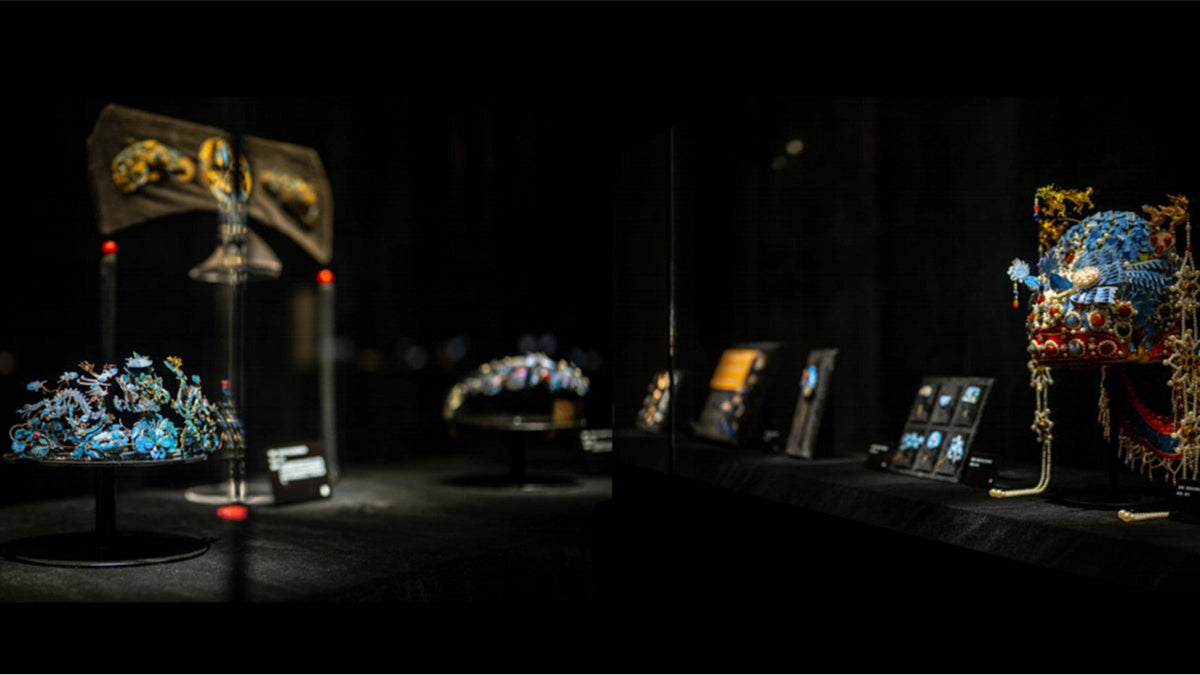
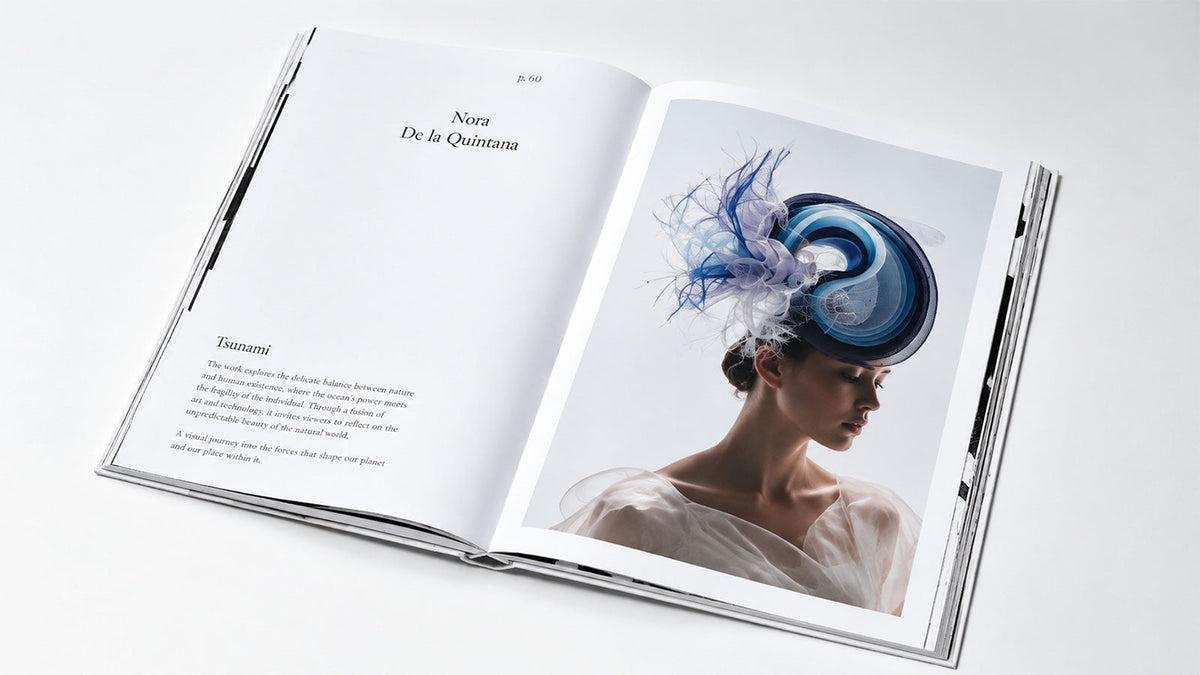
Most conversations about heritage headwear start with the famous techniques: feathers, filigree, brocade. The crafts in this article are quieter. One starts with bamboo and mulberry paper, one with a chicken egg, one with tree sap on a linen-wrapped wooden core, and one with silk thread laid across mesh. None was invented for hats. Yet in the "Heritage Crowns · Eastern Radiance" presentation from the Nantong Foremost Hats Museum, each is paired with a finished headpiece, and the closing idea is simple: a craft lasts longest when it returns to daily life. A hat is about as daily as an object gets.
🔽 Quick Navigation
- 📌 Why Paper, Shell, and Lacquer Belong in Couture Millinery
- 📌 The Oil Paper Umbrella: Bamboo Ribs and Tung Oil Turned into a Halo
- 📌 Eggshell Carving: Ultra-Thin Shell as a Fascinator Centrepiece
- 📌 Gold Lacquer Inlay and Ca Jin Embroidery: Two Surface Crafts, Two Textures
- 📌 Heritage Craft Comparison: How Each Material Behaves on a Headpiece
- 📌 Conclusion
- ❓FAQ
Why Paper, Shell, and Lacquer Belong in Couture Millinery

Intangible cultural heritage crafts are skills rather than objects: methods of cutting, coating, carving and stitching that a community keeps alive by passing them from one craftsperson to the next. The four crafts here share a quality that suits sculptural headwear unusually well. They are structural. Bamboo ribs hold a shape in the air, an eggshell holds a carved pattern, layered lacquer builds a hard skin, and mesh holds a stitch pattern in tension. In couture millinery that logic matters, because a headpiece has to balance weight, sit at the right angle, and survive being worn.
The examples come from the Foremost Hat Museum in Nantong, whose collection runs to nearly 7,000 pieces: historical and contemporary hats, hat-making tools, lacework, embroidery and related artefacts from East and West. Seen side by side, old pieces and new handmade headpieces make the same point about Chinese traditional crafts. They were rarely made to sit in a case. They were made to be used, carried and worn.
The Oil Paper Umbrella: Bamboo Ribs and Tung Oil Turned into a Halo

An oil paper umbrella is built from bamboo ribs and mulberry paper. The paper is coated layer by layer with natural tung oil, which is what makes it waterproof, and the canopy is often hand-painted with landscapes, flowers and birds. The museum's materials describe the craft as a blend of practicality and grace that carries wishes for completeness and good fortune. The form is not only Chinese: Wikipedia's overview notes that it originated in China and spread across East, South and Southeast Asia, and that it has long been a traditional wedding item, with a red umbrella held over the bride on her arrival.
On a headpiece, the interesting part is not the canopy but the skeleton. In the museum's showcase piece, the radiating ribs become a halo-like ring around the head, while curling, brightly coloured motifs sit on a close-fitting cap. The logic is architectural. Thin bamboo splits are light, they fan out from a single hub, and they can be spaced evenly to hold a large circle in the air with very little weight. The paper and oil layers also give any painted surface a protective finish, although a decorative headpiece should still be treated as a display-grade object rather than as rain gear. It is a good example of how handmade headpieces can borrow the engineering of an everyday object from the long tradition of Chinese traditional crafts and give it a second life on the head.
Eggshell Carving: Ultra-Thin Shell as a Fascinator Centrepiece

Eggshell carving was known as carved chicken eggs in ancient times. The shell is emptied and dried first. Then artisans use fine cutters for intaglio, relief and hollow-out carving, etching landscapes, flowers and birds onto a shell that is ultra-thin. The museum's own description sums it up neatly: tiny eggshells holding boundless scenes, a delicate craft forged on fragile material.
That scale is exactly why the craft fits a fascinator. In the museum's pairing, a carved egg is set like a cameo inside a gold-toned openwork frame, ringed with hand-strung pearls and mounted on a comb. Because the ornament is small and very light, it can sit off-centre without pulling on the head. Its fragility also changes how the piece is made: the shell needs a protective mount, and the finished headpiece needs careful packing. This is one place where couture millinery differs from production work, since the whole design is built around the weakest component.
Small-format pieces like this belong to the wider effort to bring craft masters and milliners together, which the 101 Heritage Crowns project documents. That project's stated aim is to integrate traditional crafts such as lacquer art, mother-of-pearl inlay, bamboo weaving and wood carving into modern millinery.
Gold Lacquer Inlay and Ca Jin Embroidery: Two Surface Crafts, Two Textures

Gold lacquer inlay is counted among the Eight Wonders of Yanjing and was an imperial craft of the Ming and Qing courts. A wooden base is reinforced with linen and coated in layers of natural raw lacquer. Inlay, carving-and-filling and painting are then combined, and the surface can be set with mother-of-pearl, jade or agate. The result is a glossy dark ground carrying solemn, elegant motifs. Britannica's history of Chinese lacquerwork records that the Kangxi emperor revived the industry in 1680 by establishing 27 workshops for artistic handicrafts within the palace precincts in Beijing, which shows how tightly court-controlled the craft once was. In the museum's headpiece, gold-outlined orchid blossoms on black are mounted on fine wires so they appear to float above a black woven base.
Ca Jin embroidery sits at the opposite end of the material scale. It comes from Nantong, Jiangsu, and is derived from traditional grid-stitch tapestry. Silk threads are worked onto mesh fabric using point colour and brocade fill stitches, and the ordered threads build rich textures that blend oriental elegance with modern decorative taste. On the featured hat, the technique appears as a band on a black wide-brim straw hat, with geometric colour blocks and black-and-white radiating stripes. Because it is a band rather than a whole crown, this kind of Chinese embroidery is one of the easiest ways to bring heritage onto a piece that is light enough for regular wear.
Heritage Craft Comparison: How Each Material Behaves on a Headpiece

The table below sets the four crafts side by side on the points that matter when a maker or a brand is scoping a heritage headwear project.
| Craft | Core materials | Structural role | Main handling note | Best base or mount |
|---|---|---|---|---|
| Oil paper umbrella craft | Bamboo ribs, mulberry paper, tung oil | Radiating frame that holds a large shape | Display-grade; avoid crushing the ribs | Headband or close-fitting cap |
| Eggshell carving | Emptied, dried eggshell | Carved centrepiece | Very fragile; needs a protective mount and packing | Comb or clip fascinator |
| Gold lacquer inlay | Wood core, linen, raw lacquer, optional shell, jade or agate | Hard, glossy decorative skin | Avoid knocks that could chip the film | Rigid crown, wire-mounted motifs |
| Ca Jin embroidery | Silk thread on mesh fabric | Woven decorative panel | Handle like fine textile; keep flat | Hatband or crown panel on straw or felt |
Reading down the "structural role" column, the pattern is clear: three of the four crafts create a shape or a surface, and only one creates a pattern on cloth. That is why the band-based approach is the most practical starting point for brands. It adds intangible cultural heritage crafts to a hat that already exists, without asking the wearer to carry a sculpture. A fascinator or a small comb piece is the next step up, and a full halo or lacquered crown is the most demanding, so the scope of a handmade headpieces project usually grows in that order.
Conclusion
These four crafts prove that intangible cultural heritage crafts do not have to stay behind glass. The oil paper umbrella contributes a light radiating frame, eggshell carving a tiny carved centrepiece, gold lacquer inlay a hard and glossy surface, and Ca Jin embroidery a woven band of colour. Each one turns a historic skill into wearable heritage headwear, and each one can be scoped honestly once you know what the material can and cannot do. For brands that want to explore heritage-inspired development, the Custom Hat service lets you specify shape, material, colour, size and packaging from your own tech pack. The museum's closing idea still applies: Chinese traditional crafts survive best when they are worn.
❓FAQ
Q1: Are these crafts officially recognised as intangible cultural heritage?
The museum's presentation labels each one as intangible cultural heritage. Recognition can sit at national, provincial or local level, so if you need an exact designation for a specific craft or maker, check the official registry for that project.
Q2: Can an eggshell-carved piece survive everyday wear?
It is better suited to occasions than to daily use. The shell is ultra-thin and fragile, so the piece should be mounted in a protective setting, worn carefully, and stored and shipped in a rigid case.
Q3: Is an oil paper umbrella headpiece waterproof?
The umbrella craft uses natural tung oil to make the paper waterproof, but a decorative headpiece built on the same idea is a display-grade object. Treat it as eventwear, not as rain protection.
Q4: Can these techniques be produced in volume?
Not in the usual factory sense. All four are executed by hand by specialist craftspeople, so they suit limited pieces, museum collaborations and custom commissions rather than large bulk runs.